Choosing Eyeglasses

When choosing eyeglasses, keep in mind that the frame should enhance the shape and features of your face. Before trying on a pair of eyeglasses, determine the overall shape of your face. The easiest way to find your face shape is to trace the outline of your face using a straight-on photo. After tracing, study the outline and determine the basic shape: is it oval, round, oblong, square, diamond or triangle?
Choose a contrasting shaped frame to complement the shape of your face.
Oval :Almost any frame will complement an oval-shaped face. Experiment with the latest trends to see what styles look best.
Round : Choose a geometric-shaped frame (rectangular) to make the face appear longer and to sharpen features.
Oblong : Widen and shorten an oblong face by wearing frames that do not extend beyond the widest part of the face. Decorative temples also add width to a long face.
Square : Reduce the sharp angles of a square face by choosing soft, curvy frames such as cat-eyes or ovals.
Diamond : Try rimless frames or soft ovals to minimize the width of the temples and to highlight the eyes.
Triangle : Soften a narrow jawbone by accentuating the eyes. Try frames that angle out at the top corners or styles with rimless bottoms. Remember that frame size should be in proportion to face size. Smaller frames are better for smaller faces, while larger frames look best on larger faces.
When selecting new eyeglasses, remember that proper fit is essential. To help find the perfect fit, consider these tips:
1. The frame should follow your eyebrow closely.
2. Your pupil should be in the center of the frame.
The frame should feel comfortable, without pulling or pinching your face.
Progressive Lenses

Progressive lenses, or no-line bifocals, are worn for the correction of presbyopia. Many people who require the use of a bifocal prefer progressive lenses because they give a more youthful appearance and are more functional. The lenses contain no visible line and progressively increase in strength as you move your eyes down the lenses.
All progressive lenses are not the same. They differ in price, depending on brand, size and function. Progressive lenses must fit precisely. Even with a perfect fit, however, many people have trouble adjusting to progressive lenses. Below are four types of progressive lenses.
1. Standard Progressive Lenses
If you are looking for an alternative to bifocals or trifocals, standard progressive lenses will work for most people, and fit most budgets. Although the price of standard progressive lenses is higher than regular flat-top bifocal or trifocal lenses, they are still quite affordable. Depending on brand name, standard progressive lenses range in price from $175-250 for the base lenses.
Standard progressive lenses will give you a fairly wide reading area, but require a certain sized frame to allow enough vertical height to give a smooth transition from distance vision down to reading. If too short a frame is chosen, the most useful reading power may be cut off when the lenses are manufactured.
2. Short Corridor Progressive Lenses
Gone are the days of having to sacrifice fashion for progressive lenses. Slightly more expensive than standard progressive lenses, short corridor progressive lenses are designed to fit into smaller frames. Because of their size, however, it takes a skilled optician to fit them properly. You may have difficulty adapting to short corridor progressive lenses because the "corridor" for reading vision is not very wide, causing distortion when you look outside of the corridor. If you look down to read, make sure you look straight ahead, not out to the sides. These specialty lenses range from $250-350.
3. Computer Progressive Lenses
Computer progressive lenses, also known as "office lenses" or "near variable focus lenses", are designed for use in an office and are intended to provide clear vision at around 16 inches to 6 feet. Computer progressive lenses are great for people needing clear vision at intermediate and near distances such as painters, artists, dentists, librarians, hair dressers, mechanics, draftsmen, and editors.
If you use a computer more than 4 hours per day, these lenses are ideal and help alleviate visual fatigue, or computer vision syndrome. These lenses also allow for better posture, making it easier to hold your head in a more natural position. Computer progressive lenses generally range in price from $150-250.
4. Premium Progressive Lenses
Premium progressive lenses are often referred to as "free-form design" or "wave-front technology." Premium progressive lenses provide a much wider, distortion-free reading area. Vision is often clearer, as these lenses are usually 100% digitally surfaced or ground. This customizes the prescription for you as well as the frame you desire. Instead of compacting a lens design, as with a short corridor progressive, the lens is totally customized so that all ranges of power fit nicely into any frame. As expected, these lenses are more expensive than standard or entry level progressive lenses. These lenses range from $400-800.
The Safest Lenses for Kids

When choosing eyeglasses for your child, safety should be your first priority. Children are prone to accidents, both at play and while participating in sports activities. Many children suffer sports-related eye injuries each year, most of which could be prevented by using the proper protective eyewear.
The best way to ensure safe vision is to choose polycarbonate lenses. More durable than regular plastic, polycarbonate lenses are very lightweight and shatter-proof. They also have the best impact resistance of any lens material. Polycarbonate lenses are actually constructed out of material that is identical to what is called "bulletproof glass." They also have built-in ultraviolet (UV) protection to protect the eyes from the sun's harmful rays. Many eye doctors choose to use only polycarbonate lenses for children's glasses.
Since the lenses are shatter-proof, a child's eyes won't be damaged by shards of flying glass or plastic if the glasses are hit hard by a ball or a bat. To keep vision clear for as long as possible, polycarbonate glasses usually come with a scratch-resistant coating. Though not scratch "proof," lenses that are treated front and back with a clear, hard coating do become more resistant to scratching.
Keep in mind, if your child is planning to play sports, make sure to choose a safety frame to hold the polycarbonate lenses. Safety sports frames are made to hold up to high impact from fast-moving balls or heavy racquets.
How To Clean Your Eyeglasses
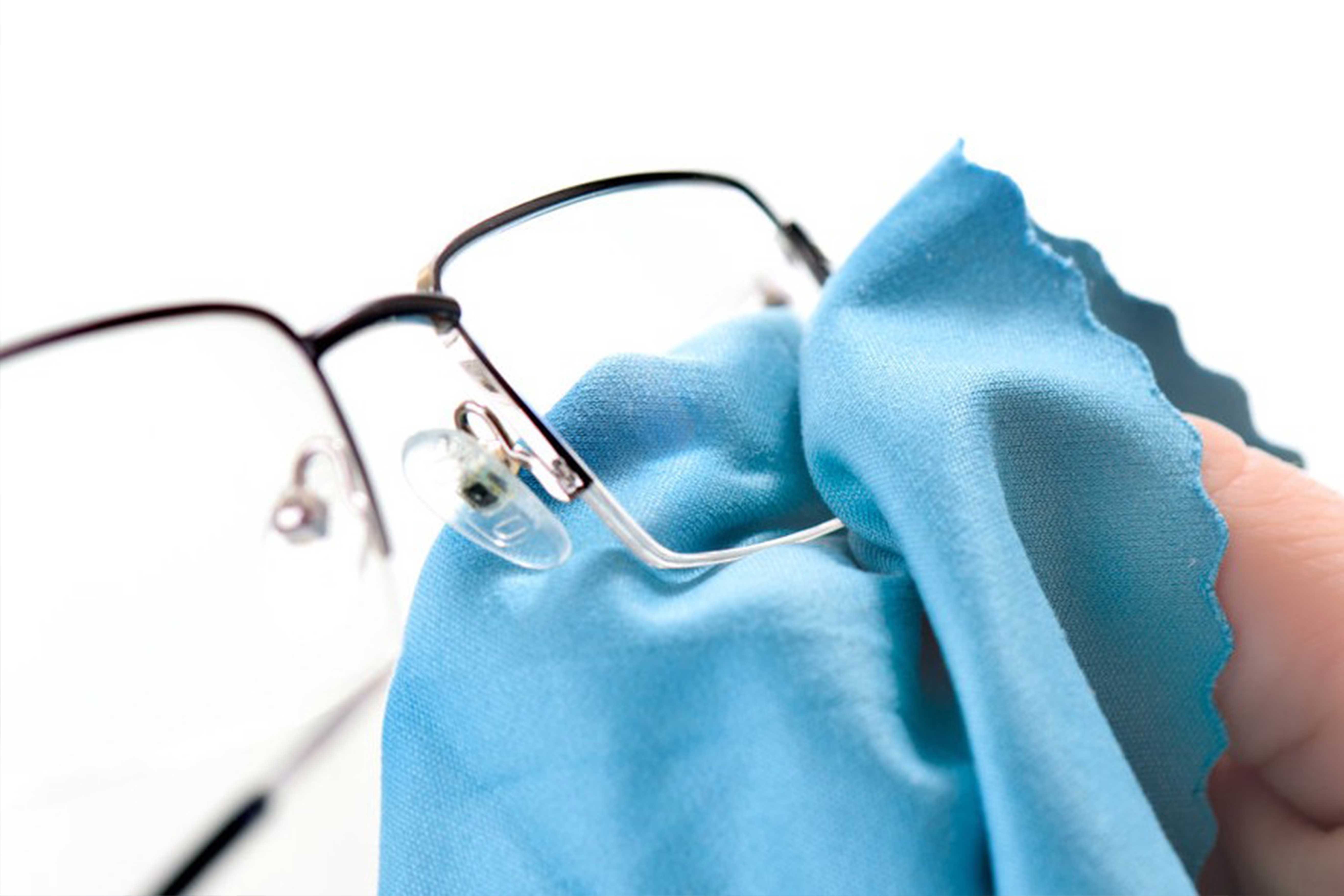
Take care of your eyeglasses by cleaning them the proper way. By following these simple tips every day, you will prolong the life of your frames and lenses.
Difficulty: Easy
Time Required: a few minutes
Here's How:
1. Rinse your glasses with water before cleaning them…this will prevent tiny particles from scratching the lenses.
2. Clean the lenses with an eyeglass spray or liquid cleaner. Gently rub both sides of the lenses, and all sides of the frame, between your thumb and forefinger.
3. Rinse with lukewarm water and dry the glasses with a soft, lint-free cotton cloth.
Tips: 1. Never lay your glasses face down…this prevents scratching the lenses.
2. Remove your glasses with both hands to prevent bending the frame.
3. Always store your glasses in a hard case.
What You Need:lukewarm water
eyeglass spray or liquid cleaner
soft, lint-free cotton cloth